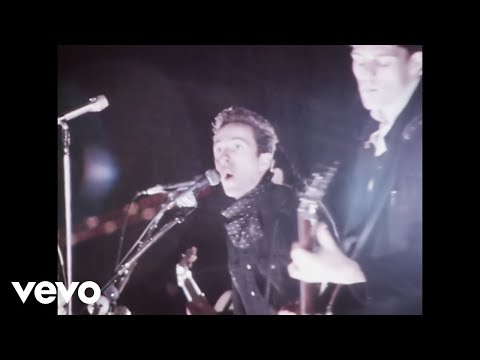
London Calling arrived in 1979 like a flare in the night: the title track of The Clash's double-album and a statement of purpose that pushed the band well beyond the narrow confines of late-70s punk. Credited to Joe Strummer and Mick Jones, the song anchored an album that mixed fury with melody, urgency with a surprising breadth of influences, and placed The Clash squarely in the role of rock's most politically alive outfit of the moment.
The record was cut at Wessex Studios in London in 1979 under the watch of producer Guy Stevens. The sessions are as much a part of the record's mythology as the songs themselves: Stevens' unpredictable methods-part provocation, part inspiration-pushed the band into performances that felt lived in and immediate rather than tidy. The session room capture is palpable in the track's weathered vocal and taut instrumental interplay; you can hear a band that is tight but not polished, deliberate but combustible. The album photo that later became iconic-Paul Simonon smashing his bass onstage-came from photographer Pennie Smith and became a visual shorthand for the record's raw energy.
Musically, "London Calling" is less a punk scream than a pastiche of rockabilly propulsion, reggae rhythm touches and classic rock drive, all filtered through The Clash's bristling sense of urgency. Joe Strummer's voice carries both warning and weary assertion, Mick Jones' guitar lines cut through like a city siren, Paul Simonon's bass underpins the song with a forward thrust, and Topper Headon's drumming keeps a taut but elastic pulse. That blend of styles was emblematic of the album as a whole-punk's attitude married to a wider musical palette-and it helped the song reach listeners who might otherwise have dismissed the band as simply another angry act.
At its heart the song is a dispatch from an anxious moment. Lyrically it reads like a series of civil-defense bulletins and neighborhood gossip turned dire: not literal reportage so much as a catalogue of impending collapse and moral fatigue. The imagery evokes Cold War dread, economic decline, and the erosion of public order, but it also operates as a broader metaphor for the failure of institutions and the sense that ordinary life is being hollowed out. Far from offering tidy answers, the song's refrains function as both a warning and a rallying cry-an insistence that listeners pay attention before it's too late.
Over time "London Calling" has accrued cultural weight far beyond its initial release. It has come to symbolize a particular historical moment in Britain-the end of the 1970s, the anxieties of the Cold War, and the social fractures of the era-while also speaking to later generations who hear in it a timeless alarm about environmental, political and social breakdowns. The album cover photo and the title phrase became visual and verbal shorthand for resistance, and the song itself turned into a touchstone for artists and activists who wanted music that could be both intellectual and immediate.
There are notable behind-the-scenes stories that surround the record. The band were moving away from the purely confrontational posture of early punk and into a more expansive creative space, which caused some friction among critics and fans at the time. The choice to pair pop hooks with apocalyptic themes was provocative: some interpreted it as selling out, others as maturation. In any case, the tension between accessibility and uncompromising content is one reason the song still feels so charged-it's pleasurable to listen to and uncomfortable to ignore.
"London Calling" has been covered and interpreted across genres, a sign of its flexible potency. Its melodies and message have lent themselves to ska, rock and stripped-down acoustic versions in clubs and stadiums alike; artists have returned to the song whenever they wanted to tap into that marriage of melody and alarm. Beyond covers, the song's title and mantra have shown up in performances, tributes and public discourse as shorthand for cultural or civic crisis.
Decades on, the track remains The Clash at their clearest: politically attuned, musically adventurous and emotionally urgent. It doesn't prescribe a single solution, which is why it continues to resonate-both as a historical document of 1979 and as a living piece of music that still asks listeners to look up from the daily noise and reckon with what might be coming next.