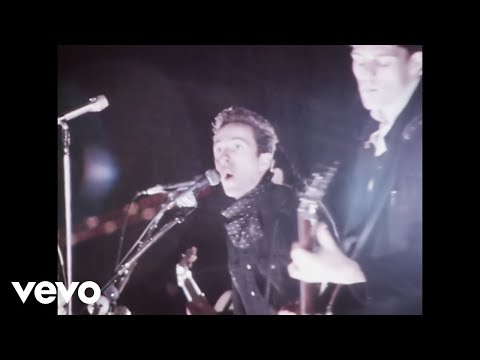
London Calling
There are few rock songs that feel as immediate and yet as thoroughly planted in a moment as the title track of The Clash's 1979 album London Calling. Released in 1979 as the lead song and namesake for the double LP, the track arrived when Britain itself was bristling with economic and cultural anxiety. Written by Joe Strummer and Mick Jones, the song serves as both headline and dispatch: shorthand for a band that had moved beyond punk's three-chord fury into something broader and more foreboding.
The recording of London Calling took place at Wessex Studios in the late summer and autumn of 1979, during sessions that were overseen by producer Guy Stevens. Those sessions are often remembered for their attempt to bottle a sense of urgency and live energy while also allowing the band room to explore a wide palette of styles - rockabilly snap, reggae off-beat, a crunching guitar that feels apocalyptic. The production emphasizes Strummer's urgent vocal delivery and a pared-down arrangement that lets the lyrics land like weather warnings.
At a musical level, London Calling is deceptively spare. The riff is immediate, the tempo driving but not frantic, and the arrangement leaves space for the words to cut through. That space is deliberate: the track frames its narrative as a series of bulletins and alarms rather than a conventional pop chorus, and the music backs that approach with a tight, forward momentum. The sonic choices make the song feel less like entertainment and more like a communique from the frontline of everyday life.
Lyrically, London Calling is a masterclass in compressed, apocalyptic reportage. Strummer and Jones stitch together images of environmental collapse, social unrest, and political unease into a stark, memorable set of lines. The language is often metaphorical - "the ice age is coming" and other weather-worn alarms - but the overall effect is unmistakable: a city and a country on the edge, catalogued with both dread and resignation. The song reads less as a manifest and more as a howl of recognition; it doesn't prescribe solutions so much as name problems and refuse to look away.
That refusal is part of what made the song culturally resonant. London Calling became shorthand for a Britain in flux and for the idea that rock music could still be a public-facing, argumentative art form. The album cover - an iconic photograph of bassist Paul Simonon smashing his instrument, captured by Pennie Smith, combined with a layout evocative of classic rock records - reinforced the song's dual lineage: rude, immediate punk energy married to rock and roll tradition. The image and the track together suggested something both destructive and reverent.
The song has also generated interesting crossovers and afterlives. It has been adopted as a rallying cry of sorts in various cultural moments and frequently appears in playlists, documentaries, and contexts that want to signal urgency or urban grit. Musicians from a wide range of genres have returned to the song, interpreting its compact drama through different lenses - a sign that its composition supports reinterpretation without losing its edge.
What endures about London Calling is its tone: equal parts alarm and reportage, a compressed novel of late-1970s anxieties in three minutes and a half. It stands as a high-water mark for The Clash not because it solved the problems it named but because it insisted on naming them plainly, with a voice that was exhausted, angry, and strangely clear-eyed. Even decades on, it reads as both a snapshot of its time and a persistent piece of cultural vocabulary - a rock record that feels like a public announcement.