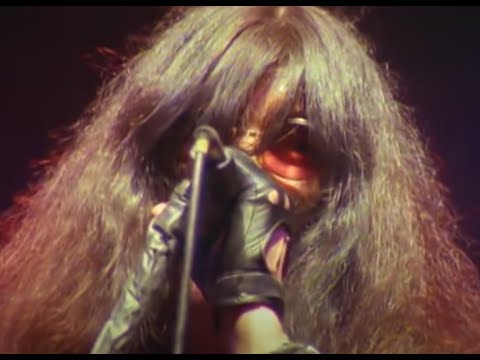
When the Ramones exploded out of a tiny New York rehearsal room and onto vinyl in 1976, "Blitzkrieg Bop" announced the arrival of a new musical shorthand: two chords, a pounding beat, and a battle cry. The song opened their self-titled debut album, Ramones, and was credited to the band's own songwriting core. It arrived whole and unapologetic, a compact slab of speed and attitude that felt like a philosophy as much as a pop song.
The recording sessions that produced Ramones' debut were famously brisk and aimed at capturing a live, kinetic energy rather than studio polish. Working in New York City with producer Craig Leon and with Tommy Ramone helping steer the band in the room, they tracked short takes and kept arrangements tight. The result was immediate: the guitars crash in, the drums stab, and Joey Ramone's snarled shout of "Hey! Ho! Let's go!" becomes the song's irresistible hook. That shouted chorus, simple and ferocious, is a studio moment that reads like a dare-minimal overdubs, maximum feel.
At its core, "Blitzkrieg Bop" is less about wartime history than about the dynamics of youth, community, and spectacle. The lyrics paint a tableau of kids assembling for something that feels both dangerous and communal: "They're forming in a straight line / They're going through a tight wind." The military metaphors-blitzkrieg, shells, rallying-are repurposed as a language of urgency, a way to describe a scene where boredom and displacement are transmuted into motion. Rather than endorsing violence, the imagery channels adolescent restlessness into the theatricalized, almost ritualistic act of going to a show, starting a mosh, or simply belonging to something loud and immediate.
Musically and culturally, the song distilled punk's promise: short songs, raw sound, and anthemic chorus anyone could shout. Its brevity-just over two minutes-helped make the point; punk wasn't interested in indulgence, it wanted to move. Over the decades "Blitzkrieg Bop" has become shorthand for that aesthetic, a tune played on repeat at countless clubs and schools of rock, and a chant adopted by crowds who may never have known its New York origin story. The phrase "Hey! Ho! Let's go!" has outlived the record and become a pop-culture exclamation in its own right.
The title and some of the imagery have occasionally stirred debate: invoking "blitzkrieg," a World War II tactic, introduces a charged word into a pop song, and critics have sometimes questioned the taste of using martial rhetoric for entertainment. Yet that tension is part of what makes the song resilient-its juxtaposition of combative language with the communal ruckus of a rock show flips the expected meaning and forces listeners to confront how we turn language of conflict into expressions of identity. The Ramones were never subtle, but their bluntness often opened up room for interpretation rather than dictating it.
"Blitzkrieg Bop" has been covered, celebrated, and co-opted across genres and generations. From punk peers to mainstream acts and tribute compilations, artists have bent it to their own energies because its structure is so elementary and its chorus so magnetic. It has also migrated into sports arenas, commercials, and film soundtracks, where its chantable hook makes it an easy shorthand for excitement and rebellion-sometimes stripped of the song's original, sharper edges and retooled into pure crowd fuel.
Decades after its release, "Blitzkrieg Bop" remains an oddly perfect artifact: both a document of a moment-New York, 1976, a band tired of frills-and a living thing that keeps being reanimated by each generation that learns to shout the words. Its power lies less in lyrical complexity than in the way it turns a handful of images into a kind of social contract: come together, make noise, be seen. In that bargain the Ramones created a musical shorthand that still refuses to be understated.