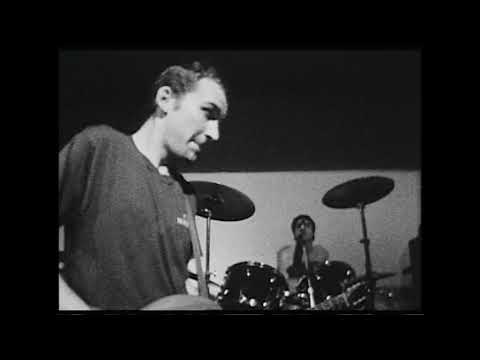
"Waiting Room" arrived like a reflex: tight, insistent, and impossibly immediate. Released as a single in 1988 and later collected on the 1989 compilation 13 Songs, it announced Fugazi not merely as a successor to earlier post-hardcore acts but as a band with a new grammar of restraint and punch. The track's two-minute economy-anchored by a hooky bass figure, abrupt pauses, and Ian MacKaye's clipped vocals-gave listeners a compact manifesto of what Fugazi would turn into a career-long practice: intensity with a conscience.
The song is credited to Fugazi as a unit, with Ian MacKaye supplying the distinctive vocal phrasing and lyrical stance that sit at the center of its meaning. Musically, Joe Lally's bass drives the opening with a patient, syncopated line that immediately sets a tension between motion and stasis. Brendan Canty's drumming shuffles under the bass like a heartbeat that only sometimes reveals itself, while Guy Picciotto's backing presence deepens the texture without ever muddying the clarity of the core groove. That arrangement-minimal but muscular-became a touchstone for the band's sound.
Recorded at Inner Ear Studios in Arlington, Virginia, the session captured more of a live interplay than a piecemeal studio construction. Don Zientara's longtime association with the Washington, D.C. scene and with Dischord Records meant that the recording environment encouraged immediacy; Fugazi laid down parts together and kept the takes brisk and taut. Notable in the tape is the stop-start dynamic that occurs almost as a punctuation mark: the band will cut out, hold a silence, then rush back in fully formed. That studio shorthand translated directly to their live performances, where the tension between hold and release became a ritualized moment audiences began to anticipate.
At its heart, "Waiting Room" is a study in boundaries and refusal. The opening line, "I am a patient boy," operates as both claim and challenge. On one level the lyric reads as a personal discipline-an insistence on composure and self-possession in the face of pressure. On another, more political level, it reads as a critique of the expectations that the music business and audience attention place on artists. The song's staccato arrangement echoes that sentiment: the band refuses to give everything away all at once. The sudden pauses and the way MacKaye's voice sometimes hovers on the edge of frustration suggest someone setting terms for engagement-taking power by withholding it rather than by surrendering to spectacle.
That interpretive core fits neatly with Fugazi's broader ethic. MacKaye's post-Minor Threat trajectory, coupled with the band's insistence on low ticket prices, all-ages shows, and independence from major-label machinations, lends the lyric a flavor of principled noncompliance. "Waiting Room" can be read as a rejection of commodified performance and instant gratification; it is an assertion that patience, autonomy, and the right to say no are themselves forms of resistance. The song's structure-measured, controlled, then explosively concise-mirrors that political and emotional architecture.
Over time the track became something of a signature for Fugazi. It was often used to open sets, a kind of clarion call that told the room what to expect: urgency without cheap theatrics. That status has produced some interesting contradictions. A song about refusal became one of the band's most recognized numbers, so widely loved that it became a doorway for fans who might then discover Fugazi's uncompromising principles. Rather than diluting the message, that popularity underscored its potency: a simple, direct statement can travel far without losing its edge.
The song hasn't spawned a wave of high-profile cover versions on record, but its influence is audible across indie and post-hardcore acts that followed. Bands have lifted its rhythmic interplay and its economy of expression as a lesson in how to say something forceful with minimal ornament. As a compact artifact of late-80s D.C. punk reinvention, "Waiting Room" still feels urgent-less a relic than a model for how music can be muscular and thoughtful at the same time.